The Night America Nuked the Sky
Honolulu threw rooftop parties to watch a nuclear test in space. Then the sky turned blood red, and some streetlights more than 1,300 km from the bomb went out.
 Premieres on YouTube Monday 09 November, 17:00 UTC · subscribe to get it
On 8 July 1962, the Honolulu Advertiser carried a headline that sounds unbelievable today:
N-blast tonight may be dazzling. Good view likely.
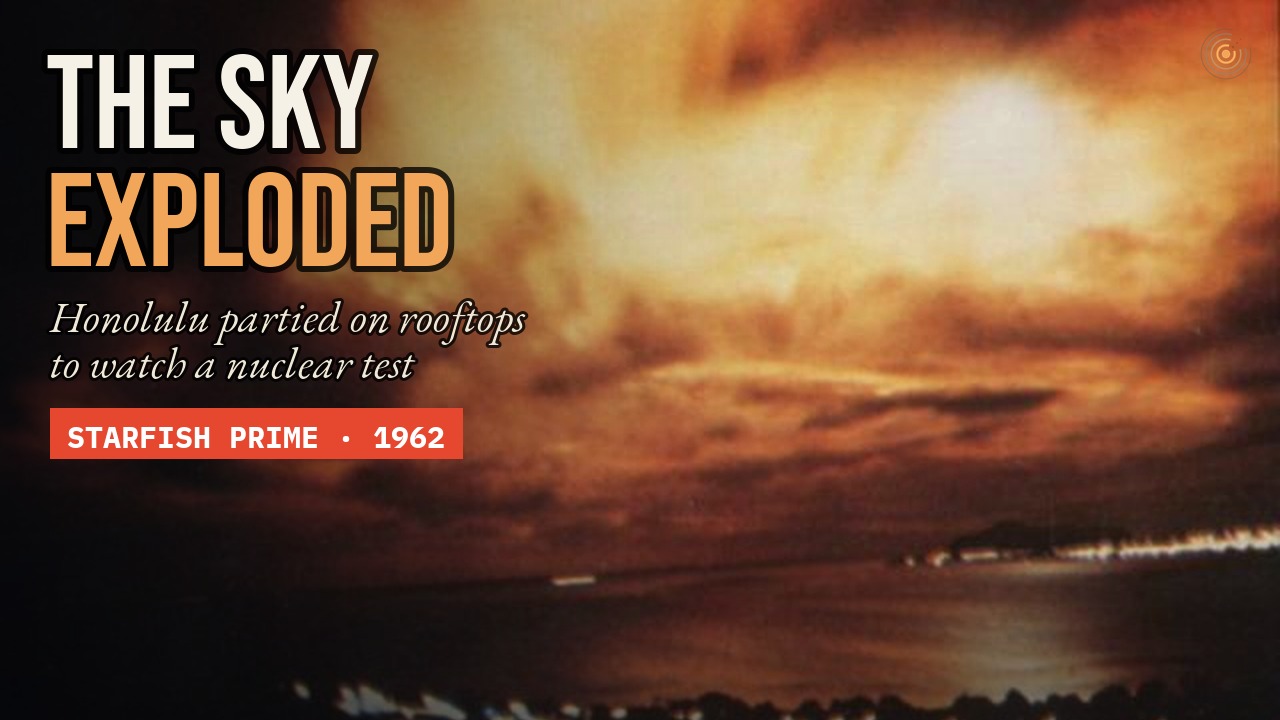
That night, hotels in Honolulu held rooftop parties. People brought drinks, and looked out to the south-west. At nine seconds past eleven, the sky turned white. Then green. Then blood red. And across Oahu, some of the streetlights went out.
More than 1,300 km away, on a tiny atoll called Johnston Island, the United States had launched a Thor missile. It carried a 1.4-megaton nuclear warhead, about 100 times the bomb that destroyed Hiroshima. 13 minutes after launch, 400 km up, it exploded.
400 km is about the height where the International Space Station flies today. The test was called Starfish Prime. It was part of a series of nuclear explosions in space, as the Cold War arms race spilled out above the atmosphere. The first attempt, nearly three weeks earlier, had failed: the missile's engine cut out, and it was destroyed, scattering radioactive debris over the island.
A New Sun
From Hawaii, the burst sat only about 10 degrees above the horizon. One Hawaiian newspaper wrote:
It looked as though the heavens had belched forth a new sun that flared briefly, but long enough to set the sky on fire.
The Pulse
But the strangest effect was invisible. The explosion released a flood of gamma rays. 20 to 40 km up, they knocked electrons out of molecules of air. Those electrons raced downwards at nearly the speed of light, and the Earth's magnetic field bent their paths. As they turned, they radiated, all together, in one enormous pulse of energy.
It's called an electromagnetic pulse, or EMP. It reached full strength in about 5 billionths of a second. In Honolulu, it blew the fuses on strings of streetlights, up to about 300 lights. Burglar alarms went off.
Scientists had expected a pulse, but nothing this strong. It took a physicist at Los Alamos, Conrad Longmire, to work out why. His explanation is still used today.
The blast also made its own aurora. Charged particles spiralled along the Earth's magnetic field lines. Over Johnston Island, a red disc hung overhead. Thousands of km to the south, where the same field lines come back down, instruments in Tonga and Samoa tracked a second aurora, and in New Zealand, people saw white shafts of light for about 12 minutes.
The Satellite Killer
And some of those particles stayed. Trapped in the Earth's magnetic field, they formed a new radiation belt around the planet. The head of the Atomic Energy Commission, Glenn Seaborg, later admitted:
To our great surprise and dismay, it developed that Starfish added significantly to the electrons in the Van Allen belts.
Over the following months, at least 6 satellites were damaged or failed. Among them was Telstar, the first satellite to relay live television across the Atlantic. It was launched the day after the blast, straight into the new belt. The extra radiation lasted for years.
The Ban
A year later, in August 1963, the United States, the Soviet Union and Britain signed a treaty that banned nuclear tests in the atmosphere, under water, and in space.
But the worry has not gone away, because today almost everything runs on electronics and satellites. As one NASA scientist put it:
A lot more things depend on computer chips and power than they did in 1962.
Remember the solar storm that set off a minefield? It shook the Earth's magnetic field over minutes. Starfish Prime did it in billionths of a second.
Epilogue
One summer night, people in Honolulu threw parties to watch a nuclear bomb. They saw a new sun, a blood-red sky, and streetlights going out, more than 1,300 km from the blast.
Key facts
- Starfish Prime, a 1.4-megaton warhead on a Thor missile, exploded 400 km above Johnston Island at 23:00:09 Honolulu time on 8 July 1962 (9 July UTC). source ↗
- The pulse blew fuses on strings of Honolulu streetlights, up to about 300 lights out of more than 10,000 on Oahu, and set off burglar alarms. source ↗
- Electrons trapped in Earth's magnetic field formed a new radiation belt that damaged at least six satellites, including Telstar 1. source ↗
- The Partial Test Ban Treaty, signed in Moscow on 5 August 1963, banned nuclear tests in the atmosphere, in space and under water. source ↗
Sources
- DASA (1962): A Quick Look at the Technical Results of Starfish Prime
- Smithsonian Magazine: Going Nuclear Over the Pacific
- NASA (Stassinopoulos 2015): The Starfish exo-atmospheric nuclear test
- Gombosi et al. (2017), Space Science Reviews: anthropogenic space weather
- National Geographic; NPR; Wikipedia: Starfish Prime, Operation Fishbowl